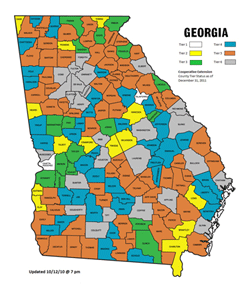
In mid-October, administrators with University of Georgia Cooperative Extension announced a new system for delivering its educational programs. That new system uses set criteria to assign each of Georgia’s 159 counties to one of six service tiers. Each tier represents what kinds and levels of service counties will receive from UGA Extension.
Implementation of the system is underway and is expected take 12 to 18 months to complete.
“Our aim with this new plan was to do all we can to ensure Georgians have access to the education and information they need from us,” said Beverly Sparks, associate dean for Extension with the UGA College of Agricultural and Environmental Sciences. “It was clear with our new budget reality we had to redesign how that education was delivered.”
UGA Extension is the public service and outreach branch of the UGA colleges of Agricultural and Environmental Sciences and Family and Consumer Sciences. For more than 100 years, it has delivered research-based education from the university to agricultural producers, families and, through Georgia 4-H, children.
“Cooperative Extension may take on a new look and feel in your county, but we will do our best to continue delivering the reliable service and education across the state that you know and trust,” Sparks said.
New look and feel
Over the past two years, all Georgia state agencies have suffered budget reductions. UGA Extension’s cut has grown to 23 percent. “When you have eliminated 88 county agent, 19 state specialist and seven administrator positions, you can no longer continue to do more with less,” Sparks said. “The time has come that we have to do what we can with what we have. We have chosen to focus on what we do best.”
Under the new system, every county will have access to a 4-H program. Most counties will have a county Extension office where residents can go for help. Support varies by tier.
Tier 1 counties include Chattahoochee and Taliaferro. These counties will have no local Extension office but will have a basic 4-H program offered in the school system through an employee supervised by an agent in another county.
Tier 2 counties include Brantley, Charlton, Clay, Crawford, Dade, Hancock, Heard, Long, Pickens, Quitman, Talbot, Towns, Twiggs and Wilkinson. These counties will have a core 4-H program and a county Extension office with an office manager to help residents access diagnostic services (soil, water and forage samples) and Extension resources. A county extension coordinator from another county will serve as administrator. Agents will be assigned as resources but will not generally offer programs or make client visits.
Tier 3 counties include Atkinson, Clinch, Dawson, Fannin, Franklin, Glascock, Jones, Lincoln, Pike, Marion, Meriwether, Rabun, Schley, Stewart, Taylor, Webster and White. These counties will have a core 4-H program, a county office staffed with an office manager and a shared agent from a surrounding county who spends time in the office.
Tier 4 counties include Baker, Baldwin, Barrow, Ben Hill, Brooks, Bryan, Butts, Catoosa, Chattooga, Cook, Dooly, Echols, Emanuel, Greene, Haralson, Harris, Irwin, Jefferson, Jenkins, Johnson, Lamar, Lee, Liberty, McIntosh, Macon, Miller, Montgomery, Murray, Newton, Peach, Polk, Terrell, Treutlen, Troup, Upson, Warren, Wilcox and Worth. These counties will have a 4-H program, a county office with a secretary, one county-based agent who may be agriculture, family and consumer science, 4-H or split between these program areas.
Tier 5 counties include Bacon, Banks, Bartow, Berrien, Bleckley, Calhoun, Camden, Candler, Carroll, Cherokee, Clarke, Columbia, Coweta, Crisp, Decatur, Dodge, Douglas, Early, Effingham, Evans, Fayette, Floyd, Gilmer, Gordon, Grady, Habersham, Hall, Hart, Jackson, Jasper, Jeff Davis, Lanier, Lowndes, Lumpkin, McDuffie, Madison, Mitchell, Monroe, Morgan, Oconee, Oglethorpe, Paulding, Pierce, Pulaski, Putnam, Randolph, Screven, Seminole, Spalding, Stephens, Tattnall, Telfair, Thomas, Toombs, Turner, Union, Walker, Walton, Ware, Wayne, Wheeler, Whitfield and Wilkes. These counties will have a 4-H program, a county office staffed with at least one support position and two or more agents – one a county coordinator -- to provide educational programs.
Tier 6 counties include Appling, Bibb, Bulloch, Burke, Chatham, Clayton, Cobb, Coffee, Colquitt, DeKalb, Dougherty, Elbert, Forsyth, Fulton, Glynn, Gwinnett, Henry, Houston, Laurens, Muscogee, Richmond, Rockdale, Tift, Sumter and Washington. These counties will have a full-time coordinator with multiple agents.
The tier rankings were determined by district Extension leadership teams, Sparks said. Under the new tier system, 126 Georgia counties are classified in Tiers 4-6, which means they will have county offices, agents and 4-H programs.
“I think our stakeholders understand the very difficult situation we’re dealing with, with the state budget, and I think they understand that we have very limited resources,” Sparks said. “Now if you’re in one of those Tier 1, 2 or 3 counties you may not be as pleased with us as if you’re in a Tier 4, 5 or 6 county. But, again, I think this plan is flexible and allows us, as resources return, to build back and bring those 1, 2 and 3 tiers up to a higher tier.”
By J Faith Peppers
University of Georgia
Image credit: Angela Rowell/ UGA.
-----
Community News You Can Use
Click to read MORE news:
www.GeorgiaFrontPage.com
Twitter: @gafrontpage & @TheGATable @HookedonHistory
www.ArtsAcrossGeorgia.com
Twitter: @artsacrossga, @softnblue, @RimbomboAAG
www.FayetteFrontPage.com
Twitter: @FayetteFP
Wednesday, November 10, 2010
Macy’s Invites You to Find Your Magic This Holiday Season with Beloved Holiday Traditions across the Country
(BUSINESS WIRE)--Year after year, Macy’s (NYSE:M) brings the magic of the Christmas season to our shoppers with a tradition of holiday events in cities across the country. Macy’s will celebrate this most magical time of the year with special events and displays awaited by children and adults alike, from the lighting of the Christmas Tree in Union Square in San Francisco, to the unveiling of the holiday windows at Macy’s State Street in Chicago to the anxiously awaited Macy’s Thanksgiving Day Parade® in New York!
“In cities across the country, Macy’s creates a magical setting to inspire the joy and goodwill of the holiday season with traditions our communities eagerly await every year,” said Martine Reardon, executive vice president of marketing, Macy’s. “At Macy’s, we always seek to help our shoppers find their magic, whether through an encounter with Santa, the anticipation of a tree lighting or through the beautiful artistry of a store window. Our third annual Believe campaign, which benefits Make-A-Wish, provides us the opportunity to share the charitable and magical message of the season year after year.”
The holiday festivities Macy’s proudly presents in Atlanta include:
THE LIGHTING OF MACY’S GREAT TREE
Thanksgiving Night, Nov. 25, 2010 at 7 p.m.
For more than six decades, generations of Atlantans have welcomed the holiday season on Thanksgiving night with the lighting of the Macy's Great Tree at Lenox Square Mall. The 63rd annual event kicks off with a show featuring performances by Katharine McPhee, Chuck Wicks and Macy's Rising Star Bobby V. and includes a fireworks finale as the tree is lit! Crowds of more than 100,000 are drawn each year for the spectacular event as a special Thanksgiving tradition.
THE PINK PIG AT MACY’S LENOX SQUARE
Saturday, Oct. 30, 2010 – Sunday Jan. 2, 2011
The Pink Pig is back this holiday season at Macy's at Lenox Square Mall in Atlanta. The beloved tradition rides again beginning Oct. 30, 2010 and will run through Jan. 2, 2011. Since its 1953 debut as a children's ride at the downtown department store Rich's, five generations of Atlantans have ridden the Pink Pig and worn the signature 'I Rode the Pink Pig' sticker with pride to kick-off the holiday season. True to tradition, a portion of the proceeds from each ride will benefit Children’s Healthcare of Atlanta. Each ride costs $3 and repeat rides have a special discounted price (2 rides for $5.50, 3 rides for $7.50).
------
Community News You Can Use
Click to read MORE news:
www.GeorgiaFrontPage.com
Twitter: @gafrontpage & @TheGATable @HookedonHistory
www.ArtsAcrossGeorgia.com
Twitter: @artsacrossga, @softnblue, @RimbomboAAG
www.FayetteFrontPage.com
Twitter: @FayetteFP
“In cities across the country, Macy’s creates a magical setting to inspire the joy and goodwill of the holiday season with traditions our communities eagerly await every year,” said Martine Reardon, executive vice president of marketing, Macy’s. “At Macy’s, we always seek to help our shoppers find their magic, whether through an encounter with Santa, the anticipation of a tree lighting or through the beautiful artistry of a store window. Our third annual Believe campaign, which benefits Make-A-Wish, provides us the opportunity to share the charitable and magical message of the season year after year.”
The holiday festivities Macy’s proudly presents in Atlanta include:
THE LIGHTING OF MACY’S GREAT TREE
Thanksgiving Night, Nov. 25, 2010 at 7 p.m.
For more than six decades, generations of Atlantans have welcomed the holiday season on Thanksgiving night with the lighting of the Macy's Great Tree at Lenox Square Mall. The 63rd annual event kicks off with a show featuring performances by Katharine McPhee, Chuck Wicks and Macy's Rising Star Bobby V. and includes a fireworks finale as the tree is lit! Crowds of more than 100,000 are drawn each year for the spectacular event as a special Thanksgiving tradition.
THE PINK PIG AT MACY’S LENOX SQUARE
Saturday, Oct. 30, 2010 – Sunday Jan. 2, 2011
The Pink Pig is back this holiday season at Macy's at Lenox Square Mall in Atlanta. The beloved tradition rides again beginning Oct. 30, 2010 and will run through Jan. 2, 2011. Since its 1953 debut as a children's ride at the downtown department store Rich's, five generations of Atlantans have ridden the Pink Pig and worn the signature 'I Rode the Pink Pig' sticker with pride to kick-off the holiday season. True to tradition, a portion of the proceeds from each ride will benefit Children’s Healthcare of Atlanta. Each ride costs $3 and repeat rides have a special discounted price (2 rides for $5.50, 3 rides for $7.50).
------
Community News You Can Use
Click to read MORE news:
www.GeorgiaFrontPage.com
Twitter: @gafrontpage & @TheGATable @HookedonHistory
www.ArtsAcrossGeorgia.com
Twitter: @artsacrossga, @softnblue, @RimbomboAAG
www.FayetteFrontPage.com
Twitter: @FayetteFP
Labels:
atlanta,
christmas,
fayette front page,
georgia,
georgia front page,
great,
lighting,
macys,
pink pig,
thanksgiving,
tree
Monday, November 8, 2010
Where's My Stimulus Package? We Hear You America!
Editor Note: Come on Georgia! Let's let the world know how great we are!
/PRNewswire/ -- Escalating unemployment, record foreclosures, an increase in the poverty level. The bad economic news doesn't seem to be stopping and the repercussions of the recession are being felt throughout the country. Reader's Digest, the world's largest global editorial brand, has a response: "We Hear You America. And we want to help."
Beginning today, Reader's Digest launches a national, grassroots campaign designed to help Americans and their hometowns with stimulus packages. The six-month long "We Hear You America" campaign will result in 100 U.S. towns, cities and people benefiting from more than $5 million worth of promotion and financial support to stimulate tourism, civic works, job growth and economic development, it was announced by Dan Lagani, President, Reader's Digest Media.
"'We Hear You America' is all about giving back to the people, towns and cities across the country that have meant so much to Reader's Digest all these years - We can't think of a better way to use the power of the Reader's Digest Brand than to turn it over to the people to tell their stories and to help their communities get back on their feet again," commented Lagani.
By going online, logging on to rd.com, typing in the name of their town and clicking on the word "cheer," anyone over age 18 in the continental U.S. will be eligible to receive a stimulus package. Individuals are encouraged to upload photos of their towns, describe their needs, talk about why their towns are "Best in America" or even comment on other submissions. The Reader's Digest "We Hear You America" program will provide stimulus to the towns that "cheer" the loudest (receive the most votes).
Additionally, as an added incentive, individuals will be entered into a sweepstakes to win a family vacation to anywhere in the continental U.S. and a brand new car to take them there. Details are provided at rd.com.
The stimulus packages will be a combination of money to be presented in person to the town mayors, national coverage in Reader's Digest editorial and local media attention.
Phase two of the program will kick off in mid-January with Reader's Digest's 100 towns in 100 days U.S. tour, coinciding with the previously announced relaunch of Reader's Digest magazine on digital platforms (including the new website Reader's Digest Version, an iPad app and the eNewsletter Reader's Digest Best You.)
"We understand this may be a difficult time for many Americans and we're happy to reach out in this way," said Lisa Sharples, president, Reader's Digest Community. "We aim to provide the greatest value to our community while offering our content to the nation in any format that they want, whenever they want it."
"The We Hear You America effort culminates with our annual 'Best of America' issue in May 2011, and promises to be our most inspiring and affecting one in the series," added Peggy Northrop, Reader's Digest Global Editor-in-Chief.
RDA is a global multi-brand media and marketing company that educates, entertains and connects audiences around the world. The company builds multi-platform communities based on branded content. With offices in 44 countries, it reaches a customer base of 130 million in 78 countries. It publishes 92 magazines, including 50 editions of Reader's Digest, the world's largest-circulation magazine, operates 78 branded websites and sells 40 million books, music and video products across the world each year. Further information about the company can be found at www.rda.com.
-----
Community News You Can Use
Click to read MORE news:
www.GeorgiaFrontPage.com
Twitter: @gafrontpage & @TheGATable @HookedonHistory
www.ArtsAcrossGeorgia.com
Twitter: @artsacrossga, @softnblue, @RimbomboAAG
www.FayetteFrontPage.com
Twitter: @FayetteFP
/PRNewswire/ -- Escalating unemployment, record foreclosures, an increase in the poverty level. The bad economic news doesn't seem to be stopping and the repercussions of the recession are being felt throughout the country. Reader's Digest, the world's largest global editorial brand, has a response: "We Hear You America. And we want to help."
Beginning today, Reader's Digest launches a national, grassroots campaign designed to help Americans and their hometowns with stimulus packages. The six-month long "We Hear You America" campaign will result in 100 U.S. towns, cities and people benefiting from more than $5 million worth of promotion and financial support to stimulate tourism, civic works, job growth and economic development, it was announced by Dan Lagani, President, Reader's Digest Media.
"'We Hear You America' is all about giving back to the people, towns and cities across the country that have meant so much to Reader's Digest all these years - We can't think of a better way to use the power of the Reader's Digest Brand than to turn it over to the people to tell their stories and to help their communities get back on their feet again," commented Lagani.
By going online, logging on to rd.com, typing in the name of their town and clicking on the word "cheer," anyone over age 18 in the continental U.S. will be eligible to receive a stimulus package. Individuals are encouraged to upload photos of their towns, describe their needs, talk about why their towns are "Best in America" or even comment on other submissions. The Reader's Digest "We Hear You America" program will provide stimulus to the towns that "cheer" the loudest (receive the most votes).
Additionally, as an added incentive, individuals will be entered into a sweepstakes to win a family vacation to anywhere in the continental U.S. and a brand new car to take them there. Details are provided at rd.com.
The stimulus packages will be a combination of money to be presented in person to the town mayors, national coverage in Reader's Digest editorial and local media attention.
Phase two of the program will kick off in mid-January with Reader's Digest's 100 towns in 100 days U.S. tour, coinciding with the previously announced relaunch of Reader's Digest magazine on digital platforms (including the new website Reader's Digest Version, an iPad app and the eNewsletter Reader's Digest Best You.)
"We understand this may be a difficult time for many Americans and we're happy to reach out in this way," said Lisa Sharples, president, Reader's Digest Community. "We aim to provide the greatest value to our community while offering our content to the nation in any format that they want, whenever they want it."
"The We Hear You America effort culminates with our annual 'Best of America' issue in May 2011, and promises to be our most inspiring and affecting one in the series," added Peggy Northrop, Reader's Digest Global Editor-in-Chief.
RDA is a global multi-brand media and marketing company that educates, entertains and connects audiences around the world. The company builds multi-platform communities based on branded content. With offices in 44 countries, it reaches a customer base of 130 million in 78 countries. It publishes 92 magazines, including 50 editions of Reader's Digest, the world's largest-circulation magazine, operates 78 branded websites and sells 40 million books, music and video products across the world each year. Further information about the company can be found at www.rda.com.
-----
Community News You Can Use
Click to read MORE news:
www.GeorgiaFrontPage.com
Twitter: @gafrontpage & @TheGATable @HookedonHistory
www.ArtsAcrossGeorgia.com
Twitter: @artsacrossga, @softnblue, @RimbomboAAG
www.FayetteFrontPage.com
Twitter: @FayetteFP
Labels:
america,
campaign,
cheer,
fayette front page,
georgia,
georgia front page,
readers digest,
recession,
stimulus,
sweepstakes,
tourism
Friday, October 22, 2010
Georgia man's death confirms presence of Africanized honeybees
Last week’s death of an elderly Dougherty County man has been attributed to Africanized honeybees. This fatality confirms the bees’ arrival in Georgia, according to the Georgia Department of Agriculture.
“The victim was operating a tractor and mower, aggravated a nest of bees and received more than 100 stings,” said Keith Delaplane, a University of Georgia Cooperative Extension entomologist.
Africanized honeybees have been in the United States since October 1990 when they were found in Texas. In 2005, they were confirmed in Florida.
European cousin essential to crops
A sub-species of honeybee, Africanized honeybees can interbreed with the European honeybee that is well known throughout Georgia as an important pollinator and producer of honey. One-third of American diets contain food crops that rely on European honeybees for pollination, according to the Georgia DOA.
Africanized and European honeybees look and behave alike in some respects. Each bee can sting only once, and there is no difference between Africanized honeybee venom and that of a European honeybee.
However, “the African variety is extremely defensive and responds with a massive stinging reaction with little provocation,” Delaplane said.
Don't swat, run, get inside and stay inside
The UGA honeybee expert urges the public to become aware of how to react if Africanized honeybees attack. He offers the following lifesaving tips:
1. Be cautious around places where Africanized honey bees are likely to nest, such as abandoned sheds, bee hive equipment, discarded tires and underground cavities.
2. If you are attacked, RUN AWAY. “You may think this sounds silly, but experience has taught us that people don’t run away,” he said. “Instead, they stand and swat, which simply escalates the defensive frenzy until it reaches lethal proportions.”
3. Get inside a closed vehicle or building as fast as possible, and STAY there. “Here’s another hard lesson we’ve learned. People don’t stay inside a closed vehicle if a few bees follow them inside,” Delaplane said. “Instead, they panic and flee back outside where tens of thousands of angry bees attack them."
This pattern has repeated itself over and over in the stinging incidents entomologists have monitored in Latin America and the southwestern U.S., he said. "The lesson is, don't worry about the few bees that follow you indoors. Get inside, and stay inside."
4. European honeybees and beekeepers are our best defense against Africanized honeybees. “Some communities may be considering zoning restrictions against all forms of beekeeping. This essentially cedes territory to the enemy. Only gentle European bees can genetically dilute the defensive Africanized variety,” he said.
First aid tips
If stung, the Georgia DOA says to follow these steps:
• Scrape – do not pull – stingers from skin as soon as possible. Pulling the stinger out will likely cause more venom to be injected into the skin.
• Wash sting area with soap and water.
• Apply ice for a few minutes to relieve pain and swelling.
• Seek medical attention if your breathing is troubled, if you’re stung numerous times or if you’re allergic to bee stings.
For more information on Africanized honeybees, read the UGA Extension publication at http://pubsadmin.caes.uga.edu/files/pdf/B%201290_2.PDF .
By Sharon Dowdy
University of Georgia
-----
Community News You Can Use
Click to read MORE news:
www.GeorgiaFrontPage.com
Twitter: @gafrontpage & @TheGATable @HookedonHistory
www.ArtsAcrossGeorgia.com
Twitter: @artsacrossga, @softnblue, @RimbomboAAG
www.FayetteFrontPage.com
Twitter: @FayetteFP
“The victim was operating a tractor and mower, aggravated a nest of bees and received more than 100 stings,” said Keith Delaplane, a University of Georgia Cooperative Extension entomologist.
Africanized honeybees have been in the United States since October 1990 when they were found in Texas. In 2005, they were confirmed in Florida.
European cousin essential to crops
A sub-species of honeybee, Africanized honeybees can interbreed with the European honeybee that is well known throughout Georgia as an important pollinator and producer of honey. One-third of American diets contain food crops that rely on European honeybees for pollination, according to the Georgia DOA.
Africanized and European honeybees look and behave alike in some respects. Each bee can sting only once, and there is no difference between Africanized honeybee venom and that of a European honeybee.
However, “the African variety is extremely defensive and responds with a massive stinging reaction with little provocation,” Delaplane said.
Don't swat, run, get inside and stay inside
The UGA honeybee expert urges the public to become aware of how to react if Africanized honeybees attack. He offers the following lifesaving tips:
1. Be cautious around places where Africanized honey bees are likely to nest, such as abandoned sheds, bee hive equipment, discarded tires and underground cavities.
2. If you are attacked, RUN AWAY. “You may think this sounds silly, but experience has taught us that people don’t run away,” he said. “Instead, they stand and swat, which simply escalates the defensive frenzy until it reaches lethal proportions.”
3. Get inside a closed vehicle or building as fast as possible, and STAY there. “Here’s another hard lesson we’ve learned. People don’t stay inside a closed vehicle if a few bees follow them inside,” Delaplane said. “Instead, they panic and flee back outside where tens of thousands of angry bees attack them."
This pattern has repeated itself over and over in the stinging incidents entomologists have monitored in Latin America and the southwestern U.S., he said. "The lesson is, don't worry about the few bees that follow you indoors. Get inside, and stay inside."
4. European honeybees and beekeepers are our best defense against Africanized honeybees. “Some communities may be considering zoning restrictions against all forms of beekeeping. This essentially cedes territory to the enemy. Only gentle European bees can genetically dilute the defensive Africanized variety,” he said.
First aid tips
If stung, the Georgia DOA says to follow these steps:
• Scrape – do not pull – stingers from skin as soon as possible. Pulling the stinger out will likely cause more venom to be injected into the skin.
• Wash sting area with soap and water.
• Apply ice for a few minutes to relieve pain and swelling.
• Seek medical attention if your breathing is troubled, if you’re stung numerous times or if you’re allergic to bee stings.
For more information on Africanized honeybees, read the UGA Extension publication at http://pubsadmin.caes.uga.edu/files/pdf/B%201290_2.PDF .
By Sharon Dowdy
University of Georgia
-----
Community News You Can Use
Click to read MORE news:
www.GeorgiaFrontPage.com
Twitter: @gafrontpage & @TheGATable @HookedonHistory
www.ArtsAcrossGeorgia.com
Twitter: @artsacrossga, @softnblue, @RimbomboAAG
www.FayetteFrontPage.com
Twitter: @FayetteFP
Labels:
africanized,
death,
dougherty,
fayette front page,
georgia,
georgia front page,
honeybees,
man,
stings
Thursday, October 14, 2010
CALLING ALL FRIENDSHIP FORCE MEMBERS: Take part in Georgia-to-Georgia Event Saturday
/PRNewswire/ -- All Friendship Force members in the Greater Atlanta region and anyone who participated in the first Friendship Force exchanges to Tbilisi, Georgia in the old Soviet Union in 1985 and 1990 are invited to Atlanta City Hall Saturday for ceremonies commemorating the anniversaries of their journeys.
Special recognition will be given to all American Georgians who traveled in those first Georgia-to-Georgia exchanges. Honored guests Saturday include U.S. Rep. Jim Marshall and Jack and Norma Hassinger, who established an orphanage in the country of Georgia.
The celebration starts at 6 p.m. on Saturday, Oct. 16, at Atlanta City Hall in downtown Atlanta.
For more information, please visit www.atscc.org, the official site of the Atlanta-Tbilisi Sister City Committee.
-----
Community News You Can Use
Click to read MORE news:
www.GeorgiaFrontPage.com
Twitter: @gafrontpage & @TheGATable @HookedonHistory
www.ArtsAcrossGeorgia.com
Twitter: @artsacrossga, @softnblue, @RimbomboAAG
www.FayetteFrontPage.com
Twitter: @FayetteFP
Special recognition will be given to all American Georgians who traveled in those first Georgia-to-Georgia exchanges. Honored guests Saturday include U.S. Rep. Jim Marshall and Jack and Norma Hassinger, who established an orphanage in the country of Georgia.
The celebration starts at 6 p.m. on Saturday, Oct. 16, at Atlanta City Hall in downtown Atlanta.
For more information, please visit www.atscc.org, the official site of the Atlanta-Tbilisi Sister City Committee.
-----
Community News You Can Use
Click to read MORE news:
www.GeorgiaFrontPage.com
Twitter: @gafrontpage & @TheGATable @HookedonHistory
www.ArtsAcrossGeorgia.com
Twitter: @artsacrossga, @softnblue, @RimbomboAAG
www.FayetteFrontPage.com
Twitter: @FayetteFP
Labels:
atlanta,
celebration,
fayette front page,
force,
friendship,
georgia,
georgia front page,
reunion
Wednesday, October 13, 2010
Show Me the Money! Portfolio.com Unveils Top 100 U.S. Cities with the Highest Income Growth Rates
/PRNewswire/ -- Portfolio.com – the national business news site for small and mid-sized business (SMB) executives – today revealed its latest U.S. Uncovered study, ranking U.S. cities with the highest income growth. The study, which looked at the nation's top 100 metropolitan areas, analyzed 25 years of federal income data to calculate how income level growth compares across the nation. El Paso, Texas, ranks in first place, with a 147 percent increase in income levels over the past 20 years.
The study used a 25-part formula to analyze the consistency and strength of per capita income (PCI) growth in each market. The formula compared each area's growth rates against the U.S. averages for 25 different time spans, yielding an overall score for income growth. All 25 spans ended in 2009, ranging in length from 25 years (1984-2009) to a single year (2008-2009).
"It's refreshing to see that the cities with the best opportunities for income growth go beyond the major metros," said J. Jennings Moss, editor of Portfolio.com. "When you consider the current high rate of unemployment in this country, our study suggests that people may want to explore job opportunities or start businesses in smaller cities, like Baton Rouge and Oklahoma City, where income growth is higher and the economy has been relativity stable in comparison to other parts of the U.S."
El Paso, which ranks as the 99th lowest per capita income of $28,638, holds first place in 13 of the 25 time spans, including a 147 percent increase in income levels between 1989 and 2009, and two percent during the recessionary period of 2008 to 2009. Meanwhile, Bridgeport-Stamford, Connecticut, which had the highest PCI in 2009 ($73,720), ranks 33 in the income growth index.
Cities with the Highest Income Growth
El Paso, Texas
Baton Rouge, La.
Baltimore, Md.
Virginia Beach-Norfolk , Va.
New Orleans, La.
Pittsburgh, Pa.
Oklahoma City, Okla.
Little Rock, Ark.
Jackson, Miss. Honolulu, Hawaii
Most cities in the top 10 have around one million or fewer inhabitants, except for Baltimore, Md. (#3) and Pittsburgh, Pa. (#6), which both have populations of more than two million. Jackson, Miss. (#9) is the metro with the lowest population at 540,866 on the top 10 listing. Rounding out the top 10 are Baton Rouge, La. (#2); Virginia Beach-Norfolk, Va. (#4); New Orleans (#5); Oklahoma City, Okla. (#7); Little Rock, Ark. (#8); and Honolulu, Hawaii (#10).
"Most people are interested in knowing what cities have the highest per capita income, but that doesn't always reflect the areas with the most available opportunities," said G. Scott Thomas, a nationally-recognized demographer who participated in the analyses for Portfolio.com. "The highest income growth rankings are designed to give the people an alternative view on what constitutes a flourishing economy and maybe even the chance for a fresh start."
Larger metros were not ranked high on the list. New York City, the area with the nation's highest population, ranks at #35; Los Angeles at #54; and Chicago at #73. The bottom three cities, Raleigh, N.C. at #98, Detroit at #99 and Atlanta at #100, have been hurt badly by declining real estate prices and the erosion of the manufacturing industry, which has contributed to declining income growth rates.
The U.S. Uncovered series provides original, insightful analysis of the American lifestyle and business trends of interest to the highly lucrative market of small- and mid-sized business executives, who will fuel the country's economic recovery over the next five years. Most recently, the U.S. Uncovered revealed the "Most Stressful Place in America," ranking Detroit as the most stressful city. The series also disclosed the rankings of "Best Mid-size Places to Live" ranking Boulder, CO as the small city with the highest quality of life; "Best Big Places to Live," ranking Raleigh as #1; "Best Cities to have fun," ranking New York City as #1; "Top U.S. Wealth Centers," naming Newport Beach as #1; "Small Business Vitality," naming Texas the best state and Austin the top city for small business; and "Best Places for Young Adults," naming the Southwestern region the new frontier for young Americans with Austin as #1.
-----
Community News You Can Use
Click to read MORE news:
www.GeorgiaFrontPage.com
Twitter: @gafrontpage & @TheGATable @HookedonHistory
www.ArtsAcrossGeorgia.com
Twitter: @artsacrossga, @softnblue, @RimbomboAAG
www.FayetteFrontPage.com
Twitter: @FayetteFP
The study used a 25-part formula to analyze the consistency and strength of per capita income (PCI) growth in each market. The formula compared each area's growth rates against the U.S. averages for 25 different time spans, yielding an overall score for income growth. All 25 spans ended in 2009, ranging in length from 25 years (1984-2009) to a single year (2008-2009).
"It's refreshing to see that the cities with the best opportunities for income growth go beyond the major metros," said J. Jennings Moss, editor of Portfolio.com. "When you consider the current high rate of unemployment in this country, our study suggests that people may want to explore job opportunities or start businesses in smaller cities, like Baton Rouge and Oklahoma City, where income growth is higher and the economy has been relativity stable in comparison to other parts of the U.S."
El Paso, which ranks as the 99th lowest per capita income of $28,638, holds first place in 13 of the 25 time spans, including a 147 percent increase in income levels between 1989 and 2009, and two percent during the recessionary period of 2008 to 2009. Meanwhile, Bridgeport-Stamford, Connecticut, which had the highest PCI in 2009 ($73,720), ranks 33 in the income growth index.
Cities with the Highest Income Growth
El Paso, Texas
Baton Rouge, La.
Baltimore, Md.
Virginia Beach-Norfolk , Va.
New Orleans, La.
Pittsburgh, Pa.
Oklahoma City, Okla.
Little Rock, Ark.
Jackson, Miss. Honolulu, Hawaii
Most cities in the top 10 have around one million or fewer inhabitants, except for Baltimore, Md. (#3) and Pittsburgh, Pa. (#6), which both have populations of more than two million. Jackson, Miss. (#9) is the metro with the lowest population at 540,866 on the top 10 listing. Rounding out the top 10 are Baton Rouge, La. (#2); Virginia Beach-Norfolk, Va. (#4); New Orleans (#5); Oklahoma City, Okla. (#7); Little Rock, Ark. (#8); and Honolulu, Hawaii (#10).
"Most people are interested in knowing what cities have the highest per capita income, but that doesn't always reflect the areas with the most available opportunities," said G. Scott Thomas, a nationally-recognized demographer who participated in the analyses for Portfolio.com. "The highest income growth rankings are designed to give the people an alternative view on what constitutes a flourishing economy and maybe even the chance for a fresh start."
Larger metros were not ranked high on the list. New York City, the area with the nation's highest population, ranks at #35; Los Angeles at #54; and Chicago at #73. The bottom three cities, Raleigh, N.C. at #98, Detroit at #99 and Atlanta at #100, have been hurt badly by declining real estate prices and the erosion of the manufacturing industry, which has contributed to declining income growth rates.
The U.S. Uncovered series provides original, insightful analysis of the American lifestyle and business trends of interest to the highly lucrative market of small- and mid-sized business executives, who will fuel the country's economic recovery over the next five years. Most recently, the U.S. Uncovered revealed the "Most Stressful Place in America," ranking Detroit as the most stressful city. The series also disclosed the rankings of "Best Mid-size Places to Live" ranking Boulder, CO as the small city with the highest quality of life; "Best Big Places to Live," ranking Raleigh as #1; "Best Cities to have fun," ranking New York City as #1; "Top U.S. Wealth Centers," naming Newport Beach as #1; "Small Business Vitality," naming Texas the best state and Austin the top city for small business; and "Best Places for Young Adults," naming the Southwestern region the new frontier for young Americans with Austin as #1.
-----
Community News You Can Use
Click to read MORE news:
www.GeorgiaFrontPage.com
Twitter: @gafrontpage & @TheGATable @HookedonHistory
www.ArtsAcrossGeorgia.com
Twitter: @artsacrossga, @softnblue, @RimbomboAAG
www.FayetteFrontPage.com
Twitter: @FayetteFP
Labels:
atlanta,
cities,
fayette front page,
georgia,
georgia front page,
growth,
income,
ranking,
rate
Tuesday, October 12, 2010
Be Someone, Inc. and National Leadership Group Come Together to Empower Single Parents
/PRNewswire/ -- To lend a helping hand to single parents, The National Leadership Group Inc. and Be Someone, Inc. will hold its second annual Single Parents Workshop Saturday, October 23, from 10:00 a.m. to 5:00 p.m. at the Georgia International Convention Center in College Park, GA.
The workshops will consist of 45-minute sessions in Money Management, Credit Counseling, Parenting Skills and other topics designed to help and assist single parents. There will also be vendors providing information for home buying and different down payment programs that are available.
"The success of the first Single Parents Workshop last year," founder Beverly Brewster explained, "led me and the National Leadership Group to conduct another workshop. With the help of Choice Events of Atlanta this year will be more exciting than last year with vendors, simultaneous workshops and breakout sessions designed to help parents and families. There's something for everyone." Prizes will be awarded throughout the day.
"We are in a race between education and disaster." - Be Someone Founder Orrin C. Hudson
A new study shows a disturbing trend facing our nation: The U.S. is losing ground in educating black males. Researchers say tens of thousands of young black males are headed for futures with low-paying jobs, continuing the cycle of generational poverty.
Only 47 percent of black males are graduating from high school compared to 78 percent of whites, according to the "Yes, We Can" study released by the Schott Foundation for Public Education. Just two years ago, the same organization found that 48 percent of black males were graduating from high school. The five worst-performing districts with large black male student enrollment exceeding 40,000 include New York City (28% of black males graduated); Philadelphia (28%); Detroit (27%); Broward County, FL (39%); and Dade County, FL (27%).
The new study underscores the fact that black males are continuing to slip through the cracks, says motivational speaker Orrin C. Hudson. The gap is one that parents and the community as a whole must work harder to close, or the U.S. will be burdened with a growing uneducated and unskilled population, Hudson said.
"We are in a race between education and disaster," Hudson said. "For too long we have given lip service for a change in our communities and it is time to GET IN THE GAME. If each one of us would make a commitment to the at-risk children in our own cities -- a commitment to mentor and influence them in a positive way -- real change can be accomplished."
Single Parents Workshop participants can obtain this $150.00 value for only $10.00 in advance by registering online or $15.00 at the door. There is no cost for children between the ages of 6-12.
Tickets can be purchased and donations can be gifted online using major credit cards or PayPal at http://www.t1tg.com. Vendors are welcome and can sign up on the website also. Checks or money orders can be sent to The National Leadership Group, Inc. POB 962546, Riverdale, GA 30296. Additional questions can be addressed at info@touchonetouchageneration.com, or by calling 770-997-6868.
-----
Community News You Can Use
Click to read MORE news:
www.GeorgiaFrontPage.com
Twitter: @gafrontpage & @TheGATable @HookedonHistory
www.ArtsAcrossGeorgia.com
Twitter: @artsacrossga, @softnblue, @RimbomboAAG
www.FayetteFrontPage.com
Twitter: @FayetteFP
The workshops will consist of 45-minute sessions in Money Management, Credit Counseling, Parenting Skills and other topics designed to help and assist single parents. There will also be vendors providing information for home buying and different down payment programs that are available.
"The success of the first Single Parents Workshop last year," founder Beverly Brewster explained, "led me and the National Leadership Group to conduct another workshop. With the help of Choice Events of Atlanta this year will be more exciting than last year with vendors, simultaneous workshops and breakout sessions designed to help parents and families. There's something for everyone." Prizes will be awarded throughout the day.
"We are in a race between education and disaster." - Be Someone Founder Orrin C. Hudson
A new study shows a disturbing trend facing our nation: The U.S. is losing ground in educating black males. Researchers say tens of thousands of young black males are headed for futures with low-paying jobs, continuing the cycle of generational poverty.
Only 47 percent of black males are graduating from high school compared to 78 percent of whites, according to the "Yes, We Can" study released by the Schott Foundation for Public Education. Just two years ago, the same organization found that 48 percent of black males were graduating from high school. The five worst-performing districts with large black male student enrollment exceeding 40,000 include New York City (28% of black males graduated); Philadelphia (28%); Detroit (27%); Broward County, FL (39%); and Dade County, FL (27%).
The new study underscores the fact that black males are continuing to slip through the cracks, says motivational speaker Orrin C. Hudson. The gap is one that parents and the community as a whole must work harder to close, or the U.S. will be burdened with a growing uneducated and unskilled population, Hudson said.
"We are in a race between education and disaster," Hudson said. "For too long we have given lip service for a change in our communities and it is time to GET IN THE GAME. If each one of us would make a commitment to the at-risk children in our own cities -- a commitment to mentor and influence them in a positive way -- real change can be accomplished."
Single Parents Workshop participants can obtain this $150.00 value for only $10.00 in advance by registering online or $15.00 at the door. There is no cost for children between the ages of 6-12.
Tickets can be purchased and donations can be gifted online using major credit cards or PayPal at http://www.t1tg.com. Vendors are welcome and can sign up on the website also. Checks or money orders can be sent to The National Leadership Group, Inc. POB 962546, Riverdale, GA 30296. Additional questions can be addressed at info@touchonetouchageneration.com, or by calling 770-997-6868.
-----
Community News You Can Use
Click to read MORE news:
www.GeorgiaFrontPage.com
Twitter: @gafrontpage & @TheGATable @HookedonHistory
www.ArtsAcrossGeorgia.com
Twitter: @artsacrossga, @softnblue, @RimbomboAAG
www.FayetteFrontPage.com
Twitter: @FayetteFP
Labels:
atlanta,
be someone,
college park,
fayette front page,
georgia,
georgia front page,
parent,
seminar,
single,
workshops
Baby Boomers Turn 65, Creating a Doctor Shortage to Care for this new Geri-Boom Population
/PRNewswire/ -- January 2011 marks a significant milestone for the "Baby Boomers" generation when its first members - born in 1946 - begin the year in which they will celebrate their 65th birthdays.
The "boomers" transition into the years that traditionally denote the beginning of senior citizenship also draws attention to the graying of America.
Stephen G. Jones, MD, a geriatrician and expert in gerontology and director of the Center for Healthy Aging at Greenwich Hospital in Greenwich, Connecticut, says the impact these so-called Geri-Boomers will have on American health care will be significant on numerous fronts.
"It is wonderful news that we are living longer, but it also creates an entirely new set of challenges for families and the health care system," says Jones. "The face of medicine is going to start to change rapidly because of this transition," he adds. While the leading cause of death in America 100 years ago was infection, "now true diseases of aging; cancer, heart disease and Alzheimer's disease are the leading causes."
One of the forthcoming issues, according to Dr. Jones, will be the shortage of doctors trained to care for an aging population. Geriatrics, the sub-specialty that focuses on the specific health needs of the elderly, is facing an acute shortage of physicians. Low insurance reimbursements rates for the care they provide and other factors have reduced the ranks of doctors seeking Geriatrics training. In 2007 only 91 American-trained doctors sought specialty in Geriatrics compared to 167 in 2003 and spots in many fellowship programs were not filled.
Who will care for this population? While the care burden, in many instances, falls on the shoulders of primary care physicians, they, too, are facing similar challenges to keep their practices solvent and viable.
Insights from Stephen G. Jones, MD, on the Geri-Boomer population:
* Boomers will number 70 million by 2030, making them the oldest generation of seniors in history. The children of Geri-Boomers will struggle to manage care for multiple generations in their families. Rather than the sandwich generation, which refers to adults caring for both their parents and their children, Dr. Jones refers to the "Club Sandwich Generation," as more adult children will be faced with the responsibilities of caring for their parents and sometimes grandchildren."
* Longevity is advancing faster than our ability to keep up with the diseases of aging. Arthritis, orthopedic problems and chronic illnesses will increasingly burden the population and the health care system.
* Alzheimer's disease, which impacted about 4.5 million Americans in 2000, will more than double in incidence by the year 2030 and is likely to reach epidemic proportions by 2050. To put this illness in perspective: A new case is diagnosed every 71 seconds and one out of eight Americans 65 and older will be diagnosed. The statistics are more staggering for those 85 and older where one out of two seniors in this age range faces a possible diagnosis.
* Seniors age 85 and older are predominately female, raising new issues for women who will spend their later years widowed or single. (Their numbers will increase from 4 million in 2000 to an estimated 31 million in 2030.)
-----
Community News You Can Use
Click to read MORE news:
www.GeorgiaFrontPage.com
Twitter: @gafrontpage & @TheGATable @HookedonHistory
www.ArtsAcrossGeorgia.com
Twitter: @artsacrossga, @softnblue, @RimbomboAAG
www.FayetteFrontPage.com
Twitter: @FayetteFP
The "boomers" transition into the years that traditionally denote the beginning of senior citizenship also draws attention to the graying of America.
Stephen G. Jones, MD, a geriatrician and expert in gerontology and director of the Center for Healthy Aging at Greenwich Hospital in Greenwich, Connecticut, says the impact these so-called Geri-Boomers will have on American health care will be significant on numerous fronts.
"It is wonderful news that we are living longer, but it also creates an entirely new set of challenges for families and the health care system," says Jones. "The face of medicine is going to start to change rapidly because of this transition," he adds. While the leading cause of death in America 100 years ago was infection, "now true diseases of aging; cancer, heart disease and Alzheimer's disease are the leading causes."
One of the forthcoming issues, according to Dr. Jones, will be the shortage of doctors trained to care for an aging population. Geriatrics, the sub-specialty that focuses on the specific health needs of the elderly, is facing an acute shortage of physicians. Low insurance reimbursements rates for the care they provide and other factors have reduced the ranks of doctors seeking Geriatrics training. In 2007 only 91 American-trained doctors sought specialty in Geriatrics compared to 167 in 2003 and spots in many fellowship programs were not filled.
Who will care for this population? While the care burden, in many instances, falls on the shoulders of primary care physicians, they, too, are facing similar challenges to keep their practices solvent and viable.
Insights from Stephen G. Jones, MD, on the Geri-Boomer population:
* Boomers will number 70 million by 2030, making them the oldest generation of seniors in history. The children of Geri-Boomers will struggle to manage care for multiple generations in their families. Rather than the sandwich generation, which refers to adults caring for both their parents and their children, Dr. Jones refers to the "Club Sandwich Generation," as more adult children will be faced with the responsibilities of caring for their parents and sometimes grandchildren."
* Longevity is advancing faster than our ability to keep up with the diseases of aging. Arthritis, orthopedic problems and chronic illnesses will increasingly burden the population and the health care system.
* Alzheimer's disease, which impacted about 4.5 million Americans in 2000, will more than double in incidence by the year 2030 and is likely to reach epidemic proportions by 2050. To put this illness in perspective: A new case is diagnosed every 71 seconds and one out of eight Americans 65 and older will be diagnosed. The statistics are more staggering for those 85 and older where one out of two seniors in this age range faces a possible diagnosis.
* Seniors age 85 and older are predominately female, raising new issues for women who will spend their later years widowed or single. (Their numbers will increase from 4 million in 2000 to an estimated 31 million in 2030.)
-----
Community News You Can Use
Click to read MORE news:
www.GeorgiaFrontPage.com
Twitter: @gafrontpage & @TheGATable @HookedonHistory
www.ArtsAcrossGeorgia.com
Twitter: @artsacrossga, @softnblue, @RimbomboAAG
www.FayetteFrontPage.com
Twitter: @FayetteFP
Labels:
baby boomers,
doctors,
fayette front page,
generation,
georgia,
georgia front page,
gerontology,
health,
seniors
Monday, October 11, 2010
Georgia summertime weather seeps into September
September was hot and dry in Georgia, with many locations setting daytime temperature records. Several locations had the hottest April-through-September period on record.
Rainfall across the state was very spotty. Severe drought returned to southeast Georgia, which missed the rainfall.
Temperatures were warmer than normal everywhere in Georgia. In Atlanta, the monthly average temperature was 78 degrees F (4.7 degrees above normal), in Athens 75.8 degrees (3.2 degrees above normal), Columbus 80.7 degrees (4.5 degrees above normal), Macon 77.4 degrees (2.9 degrees above normal), Savannah 79.4 degrees (2.5 degree above normal), Brunswick 80.7 degrees (2.6 degrees above normal), Alma 78.9 degrees (1.6 degrees above normal), Valdosta 80 degrees (3.3 degrees above normal) and Augusta 76.7 degrees (2.9 degrees above normal). Sweltering conditions set many new daytime temperature records. Atlanta set new records Sept. 11 with 96 degrees, breaking the old record of 95 degrees set on that date in 2002, and again Sept. 25 with 93 degrees, breaking the old record of 92 degrees set on that date in 1993.
Columbus broke daily highs Sept. 11 (99 degrees), Sept. 12 (98 degrees), Sept. 18 (98 degrees), Sept. 19 (97 degrees), Sept. 20 (98 degrees) and Sept. 21 (98 degrees), breaking records from the 1990s and 2002 by 1 to 3 degrees.
Brunswick also set daytime high records Sept. 9 (98 degrees), Sept. 10 (97 degrees), Sept. 11 (98 degrees) and Sept. 20 (97 degrees). Daytime high temperature records were tied at many other locations across the state.
Several airport locations recorded their warmest April through September ever, including Savannah, Athens and Columbus. Columbus had its warmest and Atlanta had its second warmest September ever due to the very warm daytime temperatures. Atlanta reported the second highest number of days above 90 degrees after the notorious summer of 1980. (The old second-place record was 84 days above 90 degrees set in the summer of 1954.)
Many areas experienced extended dry spells punctuated by a few heavy rainfalls. Generally, the central part of the state was the wettest with above-average rainfall. Border regions were well below normal, particularly the southeastern coast.
The highest monthly total from National Weather Service reporting stations was 7.32 inches in Valdosta (3.52 inches above normal). The lowest was in Brunswick at 1.47 inches (4.77 inches below normal). Athens received 5.35 inches (1.82 inches above normal), Alma 3.31 inches (.03 inch below normal), Atlanta 1.60 inches (2.49 inches below normal), Columbus 3.17 inches (.10 inches above normal), Macon 5.45 inches (1.82 inches above normal), Savannah 3.01 inches (2.07 inches below normal) and Augusta 1.89 inches (1.70 inches below normal).
Columbus got 1.85 inches of rain Sept. 26, breaking the old record of 1.55 inches for that date in 1953.
The highest single-day rainfall from Community Collaborative Rain, Hail and Snow Network stations was 6.33 inches reported in Lexington, Oglethorpe County, Sept. 27. An observer in Taylor County received 6.07 inches on that date. The highest monthly rainfall total from the network was 9.57 inches at the Lexington site, followed by 9.06 inches in Oglethorpe County and 9.04 inches in Lowndes County.
Scattered wind damage hit somewhere in Georgia on three days during the month. Moderate-sized hail was reported at several locations in northern Georgia Sept. 27, including golf ball-sized hail in Fulton County. No tornadoes were reported.
The dry conditions affected the development of peanuts across Georgia in non-irrigated fields, leading producers to harvest early. Pastures were severely affected by the lack of rain.
By Pam Knox
University of Georgia
-----
Community News You Can Use
Click to read MORE news:
www.GeorgiaFrontPage.com
Twitter: @gafrontpage & @TheGATable @HookedonHistory
www.ArtsAcrossGeorgia.com
Twitter: @artsacrossga, @softnblue, @RimbomboAAG
www.FayetteFrontPage.com
Twitter: @FayetteFP
Rainfall across the state was very spotty. Severe drought returned to southeast Georgia, which missed the rainfall.
Temperatures were warmer than normal everywhere in Georgia. In Atlanta, the monthly average temperature was 78 degrees F (4.7 degrees above normal), in Athens 75.8 degrees (3.2 degrees above normal), Columbus 80.7 degrees (4.5 degrees above normal), Macon 77.4 degrees (2.9 degrees above normal), Savannah 79.4 degrees (2.5 degree above normal), Brunswick 80.7 degrees (2.6 degrees above normal), Alma 78.9 degrees (1.6 degrees above normal), Valdosta 80 degrees (3.3 degrees above normal) and Augusta 76.7 degrees (2.9 degrees above normal). Sweltering conditions set many new daytime temperature records. Atlanta set new records Sept. 11 with 96 degrees, breaking the old record of 95 degrees set on that date in 2002, and again Sept. 25 with 93 degrees, breaking the old record of 92 degrees set on that date in 1993.
Columbus broke daily highs Sept. 11 (99 degrees), Sept. 12 (98 degrees), Sept. 18 (98 degrees), Sept. 19 (97 degrees), Sept. 20 (98 degrees) and Sept. 21 (98 degrees), breaking records from the 1990s and 2002 by 1 to 3 degrees.
Brunswick also set daytime high records Sept. 9 (98 degrees), Sept. 10 (97 degrees), Sept. 11 (98 degrees) and Sept. 20 (97 degrees). Daytime high temperature records were tied at many other locations across the state.
Several airport locations recorded their warmest April through September ever, including Savannah, Athens and Columbus. Columbus had its warmest and Atlanta had its second warmest September ever due to the very warm daytime temperatures. Atlanta reported the second highest number of days above 90 degrees after the notorious summer of 1980. (The old second-place record was 84 days above 90 degrees set in the summer of 1954.)
Many areas experienced extended dry spells punctuated by a few heavy rainfalls. Generally, the central part of the state was the wettest with above-average rainfall. Border regions were well below normal, particularly the southeastern coast.
The highest monthly total from National Weather Service reporting stations was 7.32 inches in Valdosta (3.52 inches above normal). The lowest was in Brunswick at 1.47 inches (4.77 inches below normal). Athens received 5.35 inches (1.82 inches above normal), Alma 3.31 inches (.03 inch below normal), Atlanta 1.60 inches (2.49 inches below normal), Columbus 3.17 inches (.10 inches above normal), Macon 5.45 inches (1.82 inches above normal), Savannah 3.01 inches (2.07 inches below normal) and Augusta 1.89 inches (1.70 inches below normal).
Columbus got 1.85 inches of rain Sept. 26, breaking the old record of 1.55 inches for that date in 1953.
The highest single-day rainfall from Community Collaborative Rain, Hail and Snow Network stations was 6.33 inches reported in Lexington, Oglethorpe County, Sept. 27. An observer in Taylor County received 6.07 inches on that date. The highest monthly rainfall total from the network was 9.57 inches at the Lexington site, followed by 9.06 inches in Oglethorpe County and 9.04 inches in Lowndes County.
Scattered wind damage hit somewhere in Georgia on three days during the month. Moderate-sized hail was reported at several locations in northern Georgia Sept. 27, including golf ball-sized hail in Fulton County. No tornadoes were reported.
The dry conditions affected the development of peanuts across Georgia in non-irrigated fields, leading producers to harvest early. Pastures were severely affected by the lack of rain.
By Pam Knox
University of Georgia
-----
Community News You Can Use
Click to read MORE news:
www.GeorgiaFrontPage.com
Twitter: @gafrontpage & @TheGATable @HookedonHistory
www.ArtsAcrossGeorgia.com
Twitter: @artsacrossga, @softnblue, @RimbomboAAG
www.FayetteFrontPage.com
Twitter: @FayetteFP
Labels:
atlanta,
columbus,
fayette front page,
georgia,
georgia front page,
rainfall,
records,
september,
weather
Wednesday, September 22, 2010
Georgia State receives $6.7 million grant for research center in health disparities
The National Institutes of Health has awarded Georgia State University with a five-year grant to start a new Center for Excellence in Health Disparities Research, which will investigate health disparity issues in Atlanta’s urban environment.
The $6.7 million grant is funded through the NIH’s National Center for Minority Health and Health Disparities. The center will include major research topics, as well as outreach programs.
The new center will be based in the Institute of Public Health of the College of Health and Human Sciences, and will include researchers from public health, social work, the Center for Healthy Development and criminal justice in the college, and faculty from the departments of African-American studies, sociology, and psychology in the College of Arts and Sciences.
Health disparities in urban areas lead to poor health, which is caused by a confluence of factors, including poverty, discrimination, unemployment, lack of access to care and the manmade environment, said Michael Eriksen, director of the Institute of Public Health.
“These factors conspire to put communities at a disadvantage in terms of health and well-being,” Eriksen said. “What we hope to do with this new, larger center of excellence is to better understand the socioeconomic forces that contribute to ill health in communities that constitute much of urban Atlanta, and the urban United States.”
Three major research areas include:
• Investigating variations in health among disadvantaged neighborhoods, especially in the wake of Atlanta’s relocation of residents traditional public housing, undertaken by Erin Ruel, assistant professor of sociology
• Examining the role of religion and churches in reducing drug use and the transmission of HIV, researched by professor Richard Rothenberg of the Institute of Public Health
• Testing the use of a way to reduce child maltreatment, called the SafeCare Model from the Center for Healthy Development, by using computers; researched by associate professor Shannon Self-Brown of the center.
The university, through its Partnership for Urban Health Research, has been working in the field for several years, and faculty have built relationships with local neighborhoods, especially relationships with the communities of Neighborhood Planning Unit-V, located near Turner Field.
The new center will allow these relationships to continue and help to benefit the community over the long term, Eriksen said.
“It all starts with developing relationships with the community,” he said. “The problem historically has been that universities will get funding for a certain project, go into the community and do the project, and then the community never hears from them again. There needs to be a trusting and sustained relationship, which we’ve established.”
The center’s community work will also involve partnerships with local non-profit organizations, churches and other faith-based organizations, housing organizations and others to collect data, analyze patterns and to perform interventions, especially in the case with the computer-assisted SafeCare project to see if problems can be prevented in the future, Eriksen said.
The grant will also fund several core areas for infrastructure, including administration, research and training for GSU students, faculty and the community, as well as a community outreach area.
Eriksen also said that the center will serve as a repository of data for health and safety in the metro Atlanta area, which researchers plan to use in conjunction with the new visualization wall at the Parker H. Petit Science Center. The wall consists of a large, 200-million pixel array of computer screens, filling up a room to allow researchers to view and analyze volumes of visual information.
-----
Community News You Can Use
www.fayettefrontpage.com
Fayette Front Page
www.georgiafrontpage.com
Georgia Front Page
Follow us on Twitter: @GAFrontPage
The $6.7 million grant is funded through the NIH’s National Center for Minority Health and Health Disparities. The center will include major research topics, as well as outreach programs.
The new center will be based in the Institute of Public Health of the College of Health and Human Sciences, and will include researchers from public health, social work, the Center for Healthy Development and criminal justice in the college, and faculty from the departments of African-American studies, sociology, and psychology in the College of Arts and Sciences.
Health disparities in urban areas lead to poor health, which is caused by a confluence of factors, including poverty, discrimination, unemployment, lack of access to care and the manmade environment, said Michael Eriksen, director of the Institute of Public Health.
“These factors conspire to put communities at a disadvantage in terms of health and well-being,” Eriksen said. “What we hope to do with this new, larger center of excellence is to better understand the socioeconomic forces that contribute to ill health in communities that constitute much of urban Atlanta, and the urban United States.”
Three major research areas include:
• Investigating variations in health among disadvantaged neighborhoods, especially in the wake of Atlanta’s relocation of residents traditional public housing, undertaken by Erin Ruel, assistant professor of sociology
• Examining the role of religion and churches in reducing drug use and the transmission of HIV, researched by professor Richard Rothenberg of the Institute of Public Health
• Testing the use of a way to reduce child maltreatment, called the SafeCare Model from the Center for Healthy Development, by using computers; researched by associate professor Shannon Self-Brown of the center.
The university, through its Partnership for Urban Health Research, has been working in the field for several years, and faculty have built relationships with local neighborhoods, especially relationships with the communities of Neighborhood Planning Unit-V, located near Turner Field.
The new center will allow these relationships to continue and help to benefit the community over the long term, Eriksen said.
“It all starts with developing relationships with the community,” he said. “The problem historically has been that universities will get funding for a certain project, go into the community and do the project, and then the community never hears from them again. There needs to be a trusting and sustained relationship, which we’ve established.”
The center’s community work will also involve partnerships with local non-profit organizations, churches and other faith-based organizations, housing organizations and others to collect data, analyze patterns and to perform interventions, especially in the case with the computer-assisted SafeCare project to see if problems can be prevented in the future, Eriksen said.
The grant will also fund several core areas for infrastructure, including administration, research and training for GSU students, faculty and the community, as well as a community outreach area.
Eriksen also said that the center will serve as a repository of data for health and safety in the metro Atlanta area, which researchers plan to use in conjunction with the new visualization wall at the Parker H. Petit Science Center. The wall consists of a large, 200-million pixel array of computer screens, filling up a room to allow researchers to view and analyze volumes of visual information.
-----
Community News You Can Use
www.fayettefrontpage.com
Fayette Front Page
www.georgiafrontpage.com
Georgia Front Page
Follow us on Twitter: @GAFrontPage
Labels:
atlanta,
disparity,
fayette front page,
georgia,
georgia front page,
georgia state,
grant,
health,
minority,
nih,
poor,
public
Monday, September 20, 2010
CVS Caremark and Direct Relief USA Announce Nearly 350 Community Clinics and Health Centers to Receive Free Flu Shot Vouchers For Their Uninsured Patients
The following health clinics and community centers will have free flu shot vouchers available for their existing patients who lack health insurance while supplies last. Vouchers are redeemable at any CVS/pharmacy for MinuteClinic location for a free flu shot.
The Athens Nurses Clinic Athens
Mercy Health Center Athens
Saint Joseph's Mercy Care Services Atlanta
Grant Park Clinic Atlanta
Georgia Farmworker Health Program Bainbridge
Good Samaritan Health And Wellness Center Jasper
Compassionate Care Clinic Milledgeville
Community Health Care Systems Sandersville
St. Mary's Health Center Savannah
JC Lewis Health Center of Union Mission Savannah
Hands of Hope Clinic Stockbridge
Primary Health Care Center Of Dade Trenton
Mercy Medical Clinic Vidalia
PRNewswire/ -- CVS Caremark and Direct Relief USA announced today that nearly 350 community clinics and health centers across the country have agreed to participate in CVS Caremark's donation of up to $5 million in free shots to patients who lack health insurance. The participating clinics and health centers will identify uninsured individuals from their existing patient populations and provide them with a free flu shot voucher, which is redeemable at any CVS/pharmacy or MinuteClinic location.
Direct Relief USA is a non-profit organization that works with 1,100 clinics and health centers in all 50 states, providing them with free medications and supplies for their low-income and uninsured patients. Most of the facilities in Direct Relief's network are affiliated with either the National Association of Community Health Centers (NACHC) or the National Association of Free Clinics (NAFC). Direct Relief USA is the largest non-profit program providing donations of medicine to patients without insurance at clinics and health centers nationwide, and was awarded the prestigious Power through partnerships award from the National Association of Community Health Centers.
CVS/pharmacy has more than 7,000 locations and MinuteClinic has more than 500 locations inside select CVS/pharmacy stores. Customers can make an appointment to receive a flu shot from a CVS pharmacist at the time, date and location of their choice by using the My Flu Shot Scheduler available at www.cvs.com/flu or by calling toll-free 1-888-FLU-SHOT (1-888-88-GRIPE for Spanish). MinuteClinic nurse practitioners are available to provide vaccinations 7 days a week during regular business hours with no appointment required.
-----
Community News You Can Use
www.fayettefrontpage.com
Fayette Front Page
www.georgiafrontpage.com
Georgia Front Page
Follow us on Twitter: @GAFrontPage
The Athens Nurses Clinic Athens
Mercy Health Center Athens
Saint Joseph's Mercy Care Services Atlanta
Grant Park Clinic Atlanta
Georgia Farmworker Health Program Bainbridge
Good Samaritan Health And Wellness Center Jasper
Compassionate Care Clinic Milledgeville
Community Health Care Systems Sandersville
St. Mary's Health Center Savannah
JC Lewis Health Center of Union Mission Savannah
Hands of Hope Clinic Stockbridge
Primary Health Care Center Of Dade Trenton
Mercy Medical Clinic Vidalia
PRNewswire/ -- CVS Caremark and Direct Relief USA announced today that nearly 350 community clinics and health centers across the country have agreed to participate in CVS Caremark's donation of up to $5 million in free shots to patients who lack health insurance. The participating clinics and health centers will identify uninsured individuals from their existing patient populations and provide them with a free flu shot voucher, which is redeemable at any CVS/pharmacy or MinuteClinic location.
Direct Relief USA is a non-profit organization that works with 1,100 clinics and health centers in all 50 states, providing them with free medications and supplies for their low-income and uninsured patients. Most of the facilities in Direct Relief's network are affiliated with either the National Association of Community Health Centers (NACHC) or the National Association of Free Clinics (NAFC). Direct Relief USA is the largest non-profit program providing donations of medicine to patients without insurance at clinics and health centers nationwide, and was awarded the prestigious Power through partnerships award from the National Association of Community Health Centers.
CVS/pharmacy has more than 7,000 locations and MinuteClinic has more than 500 locations inside select CVS/pharmacy stores. Customers can make an appointment to receive a flu shot from a CVS pharmacist at the time, date and location of their choice by using the My Flu Shot Scheduler available at www.cvs.com/flu or by calling toll-free 1-888-FLU-SHOT (1-888-88-GRIPE for Spanish). MinuteClinic nurse practitioners are available to provide vaccinations 7 days a week during regular business hours with no appointment required.
-----
Community News You Can Use
www.fayettefrontpage.com
Fayette Front Page
www.georgiafrontpage.com
Georgia Front Page
Follow us on Twitter: @GAFrontPage
Labels:
cvs,
fayette front page,
flu,
free,
georgia,
georgia front page,
shots,
uninsured,
vaccines,
vouchers
Drought conditions expand into west, south Georgia
Mild to moderate drought conditions have expanded over the past month to include much of west and south Georgia. With temperatures remaining above normal and rainfall below normal, soils continue to dry across the entire state.
Daytime high temperatures through the middle of September have generally been in the 90s across the piedmont and coastal plain. Rainfall for the past month has been between 50 percent and 70 percent of normal for most of the state. The exceptions are northeast Georgia and the lower Savannah River valley, where rainfall has been slightly above normal. Over the past two weeks, rainfall has been less than half of normal across the entire state.
Mild to moderate drought conditions exist in counties south and west of Haralson, Paulding, Douglas, Carroll, Harris, Troup, Muscogee, Chattahoochee, Marion, Schley, Sumter, Crisp, Wilcox, Telfair, Jeff Davis, Appling, Wayne and McIntosh counties, inclusive.
Mild drought conditions also exist in Lincoln, Wilkes and Elbert counties. The remainder of the state is classified as abnormally dry.
Currently, lack of soil moisture is the major drought impact. Across the southern half of the coastal plain, soil moisture is running at the fifth percentile. That means that 95 out of 100 years we would expect the soils to be wetter than they currently are in this region.
Dry soil, mixed blessing
The soil dryness has been a mixed blessing for farmers. For crops that are mature, this has made harvesting easier. The exception is peanuts. Producers are irrigating fields so that peanuts can be dug, or harvested from the ground. Many crops have not reached maturity and still need some moisture.
Streams are dropping across the state. In southwest Georgia, stream flows are near the 10th percentile. At that percentile we expect more water in the streams 90 out of 100 years. In south-central Georgia, the Little River near Adel and the Withlacoochee River near Quitman are at record low flows for the middle of September.
Across northwest Georgia, stream flows are also near the 10th percentile. Conditions across northeast Georgia are marginally better with stream flows generally around the 20th percentile, which means the streams would have more water flow 80 out of 100 years.
Wildfire risk
As the dryness worsens over the next few weeks, wildfire danger will increase. Currently, wildfire danger across the state is rated from high to extreme. Anyone involved in outside activities needs to be very cautious. Because of the dryness, any fire, regardless of how small, can quickly get out of control. Contact the Georgia Forestry Commission for specific details concerning wildfire risk and outdoor burn permits and requirements.
Dryness across the state is expected to increase over the next several weeks unless Georgia receives beneficial rains from one or more tropical disturbances, such as a tropical storm or hurricane.
Through the winter, the dryness may increase. The ocean-atmosphere system has switched to a La Niña pattern. The La Niña pattern is associated with dry, warm winters across much of the Southeast. This means that we may have minimal recharge of the hydrologic system this winter. This increases the probability of widespread and significant drought for next year. It is too early to tell exactly how the La Niña pattern will impact Georgia, but we need to be aware of the possible short-term tropical impacts and the long-term drought impacts.
Up-to-date information on dry conditions across Georgia can be found at www.georgiadrought.org. Updated weather conditions can be found at www.georgiaweather.net.
By David E. Stooksbury
University of Georgia
-----
Community News You Can Use
www.fayettefrontpage.com
Fayette Front Page
www.georgiafrontpage.com
Georgia Front Page
Follow us on Twitter: @GAFrontPage
Daytime high temperatures through the middle of September have generally been in the 90s across the piedmont and coastal plain. Rainfall for the past month has been between 50 percent and 70 percent of normal for most of the state. The exceptions are northeast Georgia and the lower Savannah River valley, where rainfall has been slightly above normal. Over the past two weeks, rainfall has been less than half of normal across the entire state.
Mild to moderate drought conditions exist in counties south and west of Haralson, Paulding, Douglas, Carroll, Harris, Troup, Muscogee, Chattahoochee, Marion, Schley, Sumter, Crisp, Wilcox, Telfair, Jeff Davis, Appling, Wayne and McIntosh counties, inclusive.
Mild drought conditions also exist in Lincoln, Wilkes and Elbert counties. The remainder of the state is classified as abnormally dry.
Currently, lack of soil moisture is the major drought impact. Across the southern half of the coastal plain, soil moisture is running at the fifth percentile. That means that 95 out of 100 years we would expect the soils to be wetter than they currently are in this region.
Dry soil, mixed blessing
The soil dryness has been a mixed blessing for farmers. For crops that are mature, this has made harvesting easier. The exception is peanuts. Producers are irrigating fields so that peanuts can be dug, or harvested from the ground. Many crops have not reached maturity and still need some moisture.
Streams are dropping across the state. In southwest Georgia, stream flows are near the 10th percentile. At that percentile we expect more water in the streams 90 out of 100 years. In south-central Georgia, the Little River near Adel and the Withlacoochee River near Quitman are at record low flows for the middle of September.
Across northwest Georgia, stream flows are also near the 10th percentile. Conditions across northeast Georgia are marginally better with stream flows generally around the 20th percentile, which means the streams would have more water flow 80 out of 100 years.
Wildfire risk
As the dryness worsens over the next few weeks, wildfire danger will increase. Currently, wildfire danger across the state is rated from high to extreme. Anyone involved in outside activities needs to be very cautious. Because of the dryness, any fire, regardless of how small, can quickly get out of control. Contact the Georgia Forestry Commission for specific details concerning wildfire risk and outdoor burn permits and requirements.
Dryness across the state is expected to increase over the next several weeks unless Georgia receives beneficial rains from one or more tropical disturbances, such as a tropical storm or hurricane.
Through the winter, the dryness may increase. The ocean-atmosphere system has switched to a La Niña pattern. The La Niña pattern is associated with dry, warm winters across much of the Southeast. This means that we may have minimal recharge of the hydrologic system this winter. This increases the probability of widespread and significant drought for next year. It is too early to tell exactly how the La Niña pattern will impact Georgia, but we need to be aware of the possible short-term tropical impacts and the long-term drought impacts.
Up-to-date information on dry conditions across Georgia can be found at www.georgiadrought.org. Updated weather conditions can be found at www.georgiaweather.net.
By David E. Stooksbury
University of Georgia
-----
Community News You Can Use
www.fayettefrontpage.com
Fayette Front Page
www.georgiafrontpage.com
Georgia Front Page
Follow us on Twitter: @GAFrontPage
Labels:
drought,
dry,
fayette front page,
georgia,
georgia front page,
mild,
rainfall,
south,
temperatures,
western
Wednesday, September 15, 2010
HHS awards $39 million to states for increasing adoptions
Georgia to receive over $364,000 as incentive
The U. S. Department of Health and Human Services today awarded $39 million to 38 states and Puerto Rico for increasing the number of children adopted from foster care. States use the funds from this adoption incentive award to improve their child welfare programs.
"All children deserve loving, safe and permanent homes," said HHS Secretary Kathleen Sebelius. "It is gratifying that most states continue to excel in promoting the adoption of children from foster care. I sincerely thank every adoptive family that has welcomed a child into their home."
States receive $4,000 for every child adopted beyond their best year's total, plus a payment of $8,000 for every child age 9 and older and $4,000 for every special needs child adopted above the respective baselines. The year 2007 is the baseline.
This year's incentive award recipients completed more adoptions in 2009 than in the 2007 baseline year.
"America's communities benefit when children grow up in stable families," said David A. Hansell, HHS acting assistant secretary for children and families. "We're very pleased that the adoption incentives program is helping states improve their programs and place more children into homes that are theirs forever."
States and territories receiving today's funding are: Alabama, Alaska, Arizona, Arkansas, Connecticut, Delaware, Florida, Georgia, Hawaii, Idaho, Illinois, Indiana, Kansas, Kentucky, Louisiana, Maine, Maryland, Michigan, Minnesota, Mississippi, Missouri, Nebraska, Nevada, New Hampshire, New Mexico, North Carolina, Oklahoma, Oregon, Pennsylvania, Rhode Island, South Carolina, South Dakota, Texas, Utah, Virginia, West Virginia, Wisconsin, Wyoming, and Puerto Rico.
-----
Community News You Can Use
www.fayettefrontpage.com
Fayette Front Page
www.georgiafrontpage.com
Georgia Front Page
Follow us on Twitter: @GAFrontPage
The U. S. Department of Health and Human Services today awarded $39 million to 38 states and Puerto Rico for increasing the number of children adopted from foster care. States use the funds from this adoption incentive award to improve their child welfare programs.
"All children deserve loving, safe and permanent homes," said HHS Secretary Kathleen Sebelius. "It is gratifying that most states continue to excel in promoting the adoption of children from foster care. I sincerely thank every adoptive family that has welcomed a child into their home."
States receive $4,000 for every child adopted beyond their best year's total, plus a payment of $8,000 for every child age 9 and older and $4,000 for every special needs child adopted above the respective baselines. The year 2007 is the baseline.
This year's incentive award recipients completed more adoptions in 2009 than in the 2007 baseline year.
"America's communities benefit when children grow up in stable families," said David A. Hansell, HHS acting assistant secretary for children and families. "We're very pleased that the adoption incentives program is helping states improve their programs and place more children into homes that are theirs forever."
States and territories receiving today's funding are: Alabama, Alaska, Arizona, Arkansas, Connecticut, Delaware, Florida, Georgia, Hawaii, Idaho, Illinois, Indiana, Kansas, Kentucky, Louisiana, Maine, Maryland, Michigan, Minnesota, Mississippi, Missouri, Nebraska, Nevada, New Hampshire, New Mexico, North Carolina, Oklahoma, Oregon, Pennsylvania, Rhode Island, South Carolina, South Dakota, Texas, Utah, Virginia, West Virginia, Wisconsin, Wyoming, and Puerto Rico.
-----
Community News You Can Use
www.fayettefrontpage.com
Fayette Front Page
www.georgiafrontpage.com
Georgia Front Page
Follow us on Twitter: @GAFrontPage
Labels:
adoption,
awards,
children,
fayette front page,
foster,
georgia,
georgia front page,
grants,
sebelius,
welfare
Tuesday, September 7, 2010
Georgia summer sets record
Georgia summers are notoriously hot. But this one has been a record-setter, with August capping a string of months with temperatures significantly above average.
For June, July and August, several airport locations recorded their warmest summer in history, including Savannah, Athens, Columbus and Alma. Other locations, like Atlanta, Macon, Augusta and Brunswick, recorded their second or third hottest summer ever. Nighttime minimum temperatures were especially high, contributing to the warm and muggy feel.
Temperatures were warmer than normal everywhere in Georgia in August. In Atlanta, the monthly average temperature was 82.8 degrees F (3.9 degrees above normal), in Athens 82.2 degrees (3.8 degrees above normal), Columbus 85.4 degrees (4.1 degrees above normal), Macon 83.8 degrees (3.8 degrees above normal), Savannah 84.2 degrees (3.4 degrees above normal), Brunswick 84.1 degrees (2.8 degrees above normal), Alma 83.8 degrees (2.7 degrees above normal), Valdosta 84.1 degrees (4.3 degrees above normal), and Augusta 82.3 degrees (3 degrees above normal).
Despite the unrelenting heat, there were no daily temperature records broken in August, although several record high temperatures and high minimum temperatures were tied. Rainfall across the state was highly variable. Some areas received more than 200 percent of normal and other areas received less than 50 percent of normal rain.
The highest monthly total from National Weather Service reporting stations was 7.62 inches in Athens (3.84 inches above normal). The lowest was Columbus at 2.45 inches (1.33 inches below normal). Valdosta received 3.48 inches (1.95 inches below normal), Alma 2.72 inches (2.78 inches below normal), Brunswick 4.94 inches (1.22 inches below normal), Atlanta 3.32 inches (.35 inch below normal), Macon 3.57 inches (.22 inch below normal), Savannah 5.30 inches (1.90 inches below normal), and Augusta 2.04 inches (2.44 inches below normal).
Record daily rainfall was set Aug. 21 in Brunswick, where 1.15 inches fell, breaking the old record of 1.04 inches set in 2009. Savannah also set a daily rainfall record of 3.21 inches Aug. 22, breaking the old record of 2.78 inches set in 1929.
The highest single-day rainfall from Community Collaborative Rain, Hail and Snow Network stations was 4.69 inches at Tybee Island Aug. 17. An observer in White County received 4.22 inches Aug. 22. The highest monthly rainfall total in August was 16.82 inches near Midway in Liberty County, followed by 14.55 inches from an observer near Sylvania in Screven County.
Scattered wind damage hit somewhere in Georgia on nine days during the month. Small hail was reported near Atlanta Aug. 28. No tornadoes were reported in August.
Weather conditions fueled the development of armyworms, which some agricultural agents listed as the worst they had seen in 25 years. They devastated pastures and hayfields in locations across the state.
By Pam Knox
University of Georgia
-----
Community News You Can Use
www.fayettefrontpage.com
Fayette Front Page
www.georgiafrontpage.com
Georgia Front Page
Follow us on Twitter: @GAFrontPage
For June, July and August, several airport locations recorded their warmest summer in history, including Savannah, Athens, Columbus and Alma. Other locations, like Atlanta, Macon, Augusta and Brunswick, recorded their second or third hottest summer ever. Nighttime minimum temperatures were especially high, contributing to the warm and muggy feel.
Temperatures were warmer than normal everywhere in Georgia in August. In Atlanta, the monthly average temperature was 82.8 degrees F (3.9 degrees above normal), in Athens 82.2 degrees (3.8 degrees above normal), Columbus 85.4 degrees (4.1 degrees above normal), Macon 83.8 degrees (3.8 degrees above normal), Savannah 84.2 degrees (3.4 degrees above normal), Brunswick 84.1 degrees (2.8 degrees above normal), Alma 83.8 degrees (2.7 degrees above normal), Valdosta 84.1 degrees (4.3 degrees above normal), and Augusta 82.3 degrees (3 degrees above normal).
Despite the unrelenting heat, there were no daily temperature records broken in August, although several record high temperatures and high minimum temperatures were tied. Rainfall across the state was highly variable. Some areas received more than 200 percent of normal and other areas received less than 50 percent of normal rain.
The highest monthly total from National Weather Service reporting stations was 7.62 inches in Athens (3.84 inches above normal). The lowest was Columbus at 2.45 inches (1.33 inches below normal). Valdosta received 3.48 inches (1.95 inches below normal), Alma 2.72 inches (2.78 inches below normal), Brunswick 4.94 inches (1.22 inches below normal), Atlanta 3.32 inches (.35 inch below normal), Macon 3.57 inches (.22 inch below normal), Savannah 5.30 inches (1.90 inches below normal), and Augusta 2.04 inches (2.44 inches below normal).
Record daily rainfall was set Aug. 21 in Brunswick, where 1.15 inches fell, breaking the old record of 1.04 inches set in 2009. Savannah also set a daily rainfall record of 3.21 inches Aug. 22, breaking the old record of 2.78 inches set in 1929.
The highest single-day rainfall from Community Collaborative Rain, Hail and Snow Network stations was 4.69 inches at Tybee Island Aug. 17. An observer in White County received 4.22 inches Aug. 22. The highest monthly rainfall total in August was 16.82 inches near Midway in Liberty County, followed by 14.55 inches from an observer near Sylvania in Screven County.
Scattered wind damage hit somewhere in Georgia on nine days during the month. Small hail was reported near Atlanta Aug. 28. No tornadoes were reported in August.
Weather conditions fueled the development of armyworms, which some agricultural agents listed as the worst they had seen in 25 years. They devastated pastures and hayfields in locations across the state.
By Pam Knox
University of Georgia
-----
Community News You Can Use
www.fayettefrontpage.com
Fayette Front Page
www.georgiafrontpage.com
Georgia Front Page
Follow us on Twitter: @GAFrontPage
Labels:
august,
fayette,
fayette front page,
fayetteville,
georgia,
georgia front page,
rainfall,
summer,
temperature,
weather
Thursday, September 2, 2010
Famed Whiskey Distillery Sets out to Make Jack Daniel’s Birthday a National Holiday
(BUSINESS WIRE)--As Americans go to the ballot box to vote for their party of choice this fall, the Jack Daniel Distillery is asking for support for a true independent -- Mr. Jack himself. In celebration of his 160th birthday this September, the “Back Jack” campaign will call on the U.S. Congress to make Jack Daniel’s birthday a national holiday and will seek supporters through a nationwide petition drive.
“It’s going to be a bit of a long shot, but we think there are plenty of Jack Daniel’s friends out there who are going to get behind our efforts to honor this legendary man.”
The man who pioneered the world’s best-selling whiskey was born in Lynchburg, Tenn., in September 1850, but due to the passage of time and fires, no one knows the exact date of his birth. While the folks at Jack Daniel’s typically just celebrate any day of the month, they decided that Mr. Jack’s independent American spirit, entrepreneurial success and worldwide recognition make him worthy of his own national holiday.
“We certainly realize there are plenty of very serious things going on in the country, but we also think folks should have a little fun with this particular campaign,” said Jack Daniel’s Master Distiller, Jeff Arnett. “It’s going to be a bit of a long shot, but we think there are plenty of Jack Daniel’s friends out there who are going to get behind our efforts to honor this legendary man.”
The “Back Jack” campaign will have a number of components:
Grass-roots Petition Campaign
From California to Maine, Florida to Washington state, Jack Daniel’s will ask its friends ages 21 and up beginning September 1st to sign the petition calling on Congress to establish a national holiday in honor of Mr. Jack’s birthday. Supporters can sign up at JDBDay.com; via Facebook and text message; at bars and other locations; and, in select cities, at the Jack Daniel’s campaign bus. At the end of the month, petitions will be delivered to Washington, D.C. and the rest will be up to our political leaders. Since we don’t know the exact date of his birth in September, whatever day Congress chooses will be fine with the Distillery.
Virtual and Viral Campaign
The official campaign headquarters for the “Back Jack” effort will be located online at JDBDay.com. From there, fans will be directed to a special Facebook application where they can sign the petition as well as see and share viral video, view a map of state-by-state campaign support, earn badges and improve their “delegate” status by getting friends to sign the petition. Those who aren’t on Facebook can virtually sign the petition by texting JDBDay to 68405. In addition, supporters should look for the Jack Daniel’s Birthday JAGTAG in various locations to view an exclusive campaign video through their mobile device.
Campaign Bus Tour
The “Back Jack” campaign will really get rolling in mid-September with a bus tour leaving from Lynchburg, Tenn., and traveling to Washington, D.C. The bus tour will collect signatures in 10 cities and will culminate on Capitol Hill at the end of September, where brand representatives will deliver the signed petition to Congress. Among the cities currently slated for campaign rally stops are Lynchburg, Nashville, Louisville, Cincinnati, Indianapolis, Detroit, Pittsburgh, Philadelphia, New York and Washington, D.C.
-----
Community News You Can Use
www.fayettefrontpage.com
Fayette Front Page
www.georgiafrontpage.com
Georgia Front Page
Follow us on Twitter: @GAFrontPage
“It’s going to be a bit of a long shot, but we think there are plenty of Jack Daniel’s friends out there who are going to get behind our efforts to honor this legendary man.”
The man who pioneered the world’s best-selling whiskey was born in Lynchburg, Tenn., in September 1850, but due to the passage of time and fires, no one knows the exact date of his birth. While the folks at Jack Daniel’s typically just celebrate any day of the month, they decided that Mr. Jack’s independent American spirit, entrepreneurial success and worldwide recognition make him worthy of his own national holiday.
“We certainly realize there are plenty of very serious things going on in the country, but we also think folks should have a little fun with this particular campaign,” said Jack Daniel’s Master Distiller, Jeff Arnett. “It’s going to be a bit of a long shot, but we think there are plenty of Jack Daniel’s friends out there who are going to get behind our efforts to honor this legendary man.”
The “Back Jack” campaign will have a number of components:
Grass-roots Petition Campaign
From California to Maine, Florida to Washington state, Jack Daniel’s will ask its friends ages 21 and up beginning September 1st to sign the petition calling on Congress to establish a national holiday in honor of Mr. Jack’s birthday. Supporters can sign up at JDBDay.com; via Facebook and text message; at bars and other locations; and, in select cities, at the Jack Daniel’s campaign bus. At the end of the month, petitions will be delivered to Washington, D.C. and the rest will be up to our political leaders. Since we don’t know the exact date of his birth in September, whatever day Congress chooses will be fine with the Distillery.
Virtual and Viral Campaign
The official campaign headquarters for the “Back Jack” effort will be located online at JDBDay.com. From there, fans will be directed to a special Facebook application where they can sign the petition as well as see and share viral video, view a map of state-by-state campaign support, earn badges and improve their “delegate” status by getting friends to sign the petition. Those who aren’t on Facebook can virtually sign the petition by texting JDBDay to 68405. In addition, supporters should look for the Jack Daniel’s Birthday JAGTAG in various locations to view an exclusive campaign video through their mobile device.
Campaign Bus Tour
The “Back Jack” campaign will really get rolling in mid-September with a bus tour leaving from Lynchburg, Tenn., and traveling to Washington, D.C. The bus tour will collect signatures in 10 cities and will culminate on Capitol Hill at the end of September, where brand representatives will deliver the signed petition to Congress. Among the cities currently slated for campaign rally stops are Lynchburg, Nashville, Louisville, Cincinnati, Indianapolis, Detroit, Pittsburgh, Philadelphia, New York and Washington, D.C.
-----
Community News You Can Use
www.fayettefrontpage.com
Fayette Front Page
www.georgiafrontpage.com
Georgia Front Page
Follow us on Twitter: @GAFrontPage
Labels:
campaign,
fayette front page,
georgia,
georgia front page,
holiday,
jack daniels,
whiskey
Subscribe to:
Posts (Atom)


